Ranking Poker Starting Hands
Furthermore, the rankings are standard for all the most popular types of poker games including No-Limit Hold’em, Pot-Limit Omaha and Seven-Card Stud. In addition to a poker hand rankings chart, also provided are answers to some of the most frequently asked questions regarding poker hand rankings, as well as the game of poker in general. You can find poker hand rankings in order at the start of the article, but to make this simple, here is a list of what beats what in poker: One Pair beats a High Card, no matter what it is. Two Pair beats One Pair hand. Three of a Kind always beats Two Pairs. Poker starting hands: playing the right cards at the right time The basic idea of poker is to play the strongest poker hands in early position, good hands in mid-position and a few more hands in the late (aka strongest) position. The 'Starting Hands Cheat Sheet' which comes as a free bonus with any of my poker strategy books can help you out with that. Lastly, if you want to learn how to start consistently making $1000 per month in low stakes poker games, make sure you grab a copy of my free poker cheat sheet.
- Poker Starting Hands Ranking Pdf
- Ranking Poker Starting Hands Spread
- Ranking Poker Starting Hands Games
Starting Hand Categories for:
Seven-Card Stud and Seven-Card Stud High-Low Eight or Better (Stud-Eight) Poker
The following terminology is useful for discussing starting hands in Seven-Card Stud High-Low poker. The table below defines 12 types of starting hands along with a description and an example of each.
| Starting Hand | Description | Example |
|---|---|---|
| Low connected-suited | Three sequential cards of the same suit with no card higher than an 8 | 3 4 5 |
| Trips | Three cards of the same rank | 9 9 9 |
| Aces with a low kicker | Two Aces with a third card no higher than an 8 | A A 2 |
| Aces with a high kicker | Two Aces with a third card higher than an 8 | A A 9 |
| Ace with two wheel cards | An Ace with two unconnected cards no higher than a 5 | A 4 5 |
| Low suited | Three cards of the same suit with no card higher than an 8 | A 5 6 |
| Low connected | Three sequential cards with no card higher than an 8 | 5 6 7 |
| High pair | Two cards ranked 9 or higher with a third unmatched card | K K 7 |
| Low pair with a low kicker | Two cards ranked 8 or lower with an unmatched card ranked 8 or lower | 5 5 7 |
| Flush with high cards | Three cards of the same suit with one or more ranked higher than an 8 | Q 6 7 |
| Low pair with a high kicker | Two cards ranked 8 or lower with an unmatched card ranked 9 or higher | 5 5 K |
| Low cards | Three cards not connected, suited or paired with no card higher than an 8 | 7 6 2 |
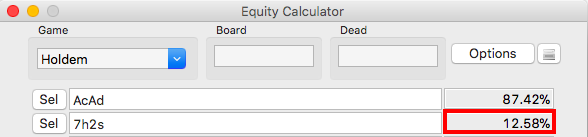
The twelve types of starting hands can be sorted into five broad categories that describe how they play. The categories of hands are: premium, big-possibility, one-way, situational and trap. The reasons for sorting the hands this way and the probabilities for each group are given.
Premium Starting Hands
The premium hands can often scoop pots without improvement. All total these starting cards are just 1% of all hands dealt. They should be played aggressively.
Trips. [Number of hands = 13, Number of combinations =52, Frequency = 0.24%, Odds = 424:1] Any rank is a powerful holding, however, low cards have the advantage of still allowing a low hand to form. Rolled trip Kings will never qualify for low. Another advantage of low rolled trips is that they are a powerful high hand that often looks like a low. In those cases the hand will generate lots of action from a player who believes incorrectly that he or she has a better high.
Aces with a low kicker. [Number of hands = 14, Number of combinations =168, Frequency = 0.76 %, Odds = 131:1] The lower the kicker the better this hand plays. Often the Aces will hold up for high unimproved or pick up a second pair to make Aces up to best two smaller pair. At the same time the hand can back into low to either scoop or save half the pot if the Aces do not hold up for high.
| Starting Hand | No. Possible | No. Combinations | Probability (%) | Odds |
|---|---|---|---|---|
| Trips | 13 | 52 | 0.24 | 424:1 |
| Aces with a low kicker | 14 | 168 | 0.76 | 131:1 |
| Totals | 27 | 220 | 1.00 | 99:1 |
Big-possibility Starting Hands
The hands in this group win the monster pots in Stud-Eight. However these hands need to improve because they are worth nothing on their own. The hands in this group can be played aggressively early on. These are rare holdings but don’t fall in love with them. If there is no improvement and a lot of action on later streets the hand should be mucked.
Low connected-suited. [Number of hands = 6, Number of combinations =24, Frequency = 0.11%, Odds = 920:1] This is one of the most powerful hands in Stud-Eight because it can scoop the entire pot in so many different ways while generating lots of action from players betting on both halves of the pot.
Low suited. [Number of hands = 50, Number of combinations =200, Frequency = 0.90%, Odds = 110:1] If an Ace is included the hand has added value. This is a good hand for jamming other players. Sometimes the hand will complete a flush for high, sometimes miss the flush but hold up for low and occasionally make high and low. Either way you can bet aggressively if this hand improves to a high or low on Fifth Street and make the others pay for your draw to the other half of the pot.
Low connected. [Number of hands = 24, Number of combinations =360, Frequency = 1.36%, Odds = 60:1] Does not have the flush possibility but low straights often scoop. A good hand for freerolling if two low cards are picked up that don’t connect. A player with a made low and an inside straight draw can jam two high hands and be assured of winning half the pot, while at the same time retaining an outside chance of a scoop.
| Starting Hand | No. Possible | No. Combinations | Probability (%) | Odds |
|---|---|---|---|---|
| Low connected-suited | 6 | 24 | 0.11 | 920:1 |
| Low suited | 50 | 200 | 0.90 | 110:1 |
| Low connected | 24 | 360 | 1.63 | 131:1 |
| Totals | 80 | 584 | 2.64 | 37:1 |
One-way Starting Hands
These starting cards typically compete for one half of the pot and are good for cases where everyone is competing for the same half of the pot. There are hands in Stud-Eight where all the players are competing for either the high half or low half of the pot. In those circumstances playing a “one-way” hand that figures to be best against the competition but can also back into the other half of the pot is a viable strategy.
Aces with a high kicker. [Number of hands = 10, Number of combinations =120, Frequency = 0.54%, Odds = 183:1] This hand usually competes for high only and it is best played against other players vying for high when it can scoop. It does poorly against multiple low draws because in that situation its only potential is for half the pot and the low draws can freeroll on later streets placing a made hand as strong as Aces-up in an uncomfortable position. This hand is most powerful when the Aces are wired because it will generate action from smaller pairs thinking that they have the best high.
Ace with two other wheel cards. [Number of hands = 20, Number of combinations =300, Frequency = 1.36%, Odds = 73:1] This hand usually competes for low only but it does have high possibilities. How well it plays often depends on where the Ace is. In most cases you want the Ace exposed so that you can threaten people with a potential pair of Aces or a potential low. That way if you pick up bricks you might win uncontested if your opponents also pick up bricks. If your opponents are weak on Fifth Street, betting an exposed A, 2, J has more fold equity than an exposed 2, 3, J.
| Starting Hand | No. Possible | No. Combinations | Probability (%) | Odds |
|---|---|---|---|---|
| Aces with a high kicker | 10 | 120 | 0.54 | 183:1 |
| Ace with two wheel cards | 20 | 300 | 1.36 | 73:1 |
| Totals | 30 | 420 | 1.90 | 52:1 |
Situational Starting Hands
Many Stud-Eight players automatically play the hands in this group. However, the viability of these hands depends highly on the situation. You should be very careful about when and how you play these hands.
High pairs 99, 10-10, JJ, QQ and KK. [Number of hands = 120, Number of combinations =1440, Frequency = 6.54%, Odds = 14:1] How well you play pairs will determine much of your profit in Stud-Eight. Automatically playing any pair as many players do will lead to disaster. As a general rule 99 and 10-10 should not be played. Paired face cards are only playable if they are the high hand on the board. You do not want to hold JJ in between a player with KK and another player with a low. The most likely outcome is that your two opponents will be dividing up your money.
Low pairs with a low kicker. [Number of hands = 98, Number of combinations =1176, Frequency = 5.32%, Odds = 18:1] These are starting hands that many Stud-Eight players will automatically play. However, as attractive these hands look, they come with a lot of problems. It is a poor start for a low hand because it has only two cards that count towards low and a poor start for a high hand because the pair is ranked so low. In other words, it is a mediocre holding to compete for either half of the pot, which means that often it will come away with nothing. Of the hands in this category, a low pair with a live Ace kicker is the most valuable because it has an outside chance of making Aces up. These hands are good for stealing antes and good for defending bring-ins against a steal. They play best heads-up against weak low draws. However, against players you know have strong holdings or against a large field these hands should not be played.
Three suited cards, one or more not low. [Number of hands = 230, Number of combinations = 920, Frequency = 4.16%, Odds = 23:1] If the suit is completely live and it is up against other high hands these starting cards have some possibilities. If the cards are connected and suited the holding is more valuable and the hand is almost playable against low draws. However, for unconnected cards, completing a flush is rare and in situations where a flush only claims half the pot you rarely have the pot odds necessary to play. As a general rule three-flushes with high cards play much worse in Stud-Eight than in Seven-Card Stud and should usually be avoided.
Poker Starting Hands Ranking Pdf
| Starting Hand | No. Possible | No. Combinations | Probability (%) | Odds |
|---|---|---|---|---|
| High pair | 120 | 1440 | 6.52 | 14:1 |
| Low pair with a low kicker | 98 | 1176 | 5.32 | 18:1 |
| Suited with high cards | 230 | 920 | 4.16 | 23:1 |
| Totals | 448 | 3536 | 17.38 | 5:1 |
Trap Starting Hands
These are attractive looking hands that play poorly and should usually be mucked. Playing hands like these for half the pot is rarely worth the investment.
Low pair with a high kicker. Hands such as 3, 3, J or 5, 5, K, have little value and in most cases should be mucked. The exceptions would be stealing antes or defending against a steal.
Three low cards (unconnected and unsuited). [Number of hands = 180, Number of combinations =2700, Frequency = 12.22%, Odds = 7.2:1] The “Razz” hands should be saved for Razz. These kinds of hands are only good for half the pot and in most cases the best you can hope for is to get your money back minus the rake. Many Stud-Eight players automatically call with these hands and stay to the end if they pick up a low draw on Fourth Street. The problem is that often if they hit low it is second best low. Just as you want to avoid playing the second best high hand, it is even more important to avoid playing the second best low hand. The high hand scoops if no one qualifies for low but a busted low is worth nothing.
| Starting Hand | No. Possible | No. Combinations | Probability (%) | Odds |
|---|---|---|---|---|
| Low pair with a high kicker | 70 | 840 | 3.80 | 25:1 |
| Low cards | 180 | 2700 | 12.22 | 7.2:1 |
| Totals | 250 | 3540 | 16.02 | 5.2:1 |
Final note: Three connected cards, one or more not low such as 8, 9, 10 or 9, 10, J play poorly in Stud-Eight and should be mucked.
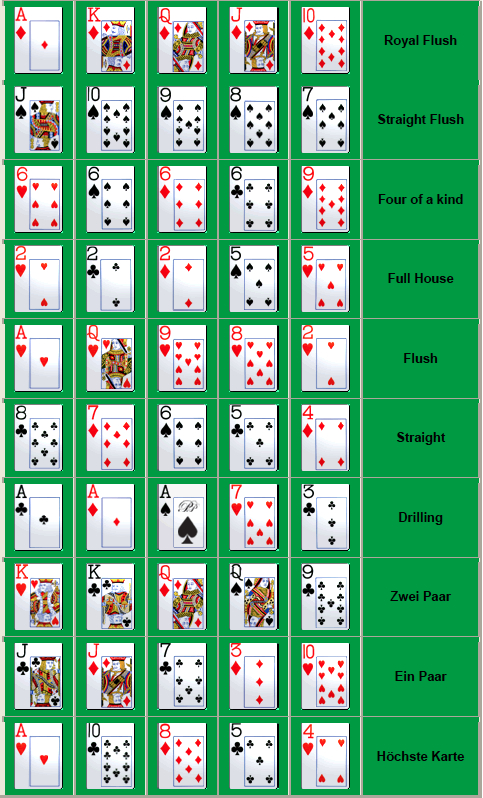
Every poker player knows that the Royal Flush is the strongest poker hand, but where do all of the other poker winning hands rank? Here is a comprehensive list of poker hands in order from highest to lowest ranking. If you are new to the game of poker, learning the different poker hands is a great first step in learning how to beat your opponents with the cards you are dealt.
#1 Royal Flush
The strongest poker hand is the royal flush. It consists of Ten, Jack, Queen, King, and Ace, all of the same suit, e.g. diamonds, spades, hearts, or clubs.
#2 Straight Flush
The second strongest hand in poker is the straight flush. It is composed of five consecutive cards of the same suit. If two players have a straight flush, the player with the highest cards wins.
#3 Four-of-a-kind
A four-of-a-kind is four cards of the same rank, e.g. four Aces. If two players have four-of-a-kind, then the one with the highest four-of-a-kind wins. If they have the same (if four-of-a-kind is on the board), then the player with the highest fifth card wins, since a poker hand is always composed of five cards.
#4 Full House
A full house is a combination of a three-of-a-kind and a pair. If two players have a full house, then the one with the highest three-of-a-kind wins. If they have the same one, then the pair counts.
#5 Flush
Five cards of the same suit make a flush. If two players have a flush, then the one with the highest cards wins.
#6 Straight
Five consecutive cards are called a straight. If two players have a straight, the one with the highest cards wins.
#7 Three-of-a-kind
A three-of-a-kind is composed of three cards of the same rank. If two players have the same three-of-a-kind, then the other cards, or both cards, determine the winner, since a poker hand is a always composed of five cards.
#8 Two-pair
Two-pair hands are, of course, composed of two pairs. If two players have two-pair, the rank of the higher pair determines the winner. If they have the same higher pair, then the lower one counts. If that is also the same, then the fifth card counts.
#9 Pair
A pair is composed of two cards of the same rank. Since a poker hand is always composed of five cards, the other three cards are so-called “kickers”. In case two players have the same pair, then the one with the highest kicker wins.
#10 High card
If you don’t even have a pair, then you look at the strength of your cards. If there are two players at showdown who don’t have a pair or better, then the one with the highest cards wins.
Any of the PalaPoker.com games use the standard rank of hands to determine the high hand.
However, at PalaPoker.com we also play “split pot” games, like Omaha Hi-Lo8 and Stud Hi-Lo8, in which the highest hand splits the pot with a qualifying (“8 or better”) low hand; therefore, we must also be familiar with:
Low Poker Hands List:
This method of ranking low hands is used in traditional Hi/Lo games, like Omaha Hi/Lo and Stud Hi/Lo, as well as in Razz, the ‘low only’ Stud game.
Note that suits are irrelevant for Ace to Five low. A flush or straight does not ‘break’ an Ace to Five low poker hand. Aces are always a ‘low’ card when considering a low hand.
Please also note that the value of a five-card low hand starts with the top card, and goes down from there.
#1 Five Low, or “Wheel“: The Five, Four, Three, Deuce and Ace.
In the event of a tie: All Five-high hands split the pot.
#2 Six Low: Any five unpaired cards with the highest card being a Six.
In the event of a tie: The lower second-highest ranking card wins the pot. Thus 6,4,3,2,A defeats 6,5,4,2,A. If necessary, the third-highest, fourth-highest and fifth-highest cards in the hand can be used to break the tie.
#3 Seven Low: Any five unpaired cards with the highest card being a Seven.
In the event of a tie: The lower second-highest ranking card wins the pot. If necessary, the third- highest, fourth-highest and fifth-highest cards in the hand can be used to break the tie.
#4 Eight Low: Any five unpaired cards with the highest card being an Eight.
Ranking Poker Starting Hands Spread
In the event of a tie: The lower second-highest ranking card wins the pot. If necessary, the third-highest, fourth-highest and fifth-highest cards in the hand can be used to break the tie. An Eight Low is the weakest hand that qualifies for low in Omaha Hi/Lo and Stud Hi/Lo.
Ranking Poker Starting Hands Games
Check back here as you are learning the game of poker for a list that details the poker hands order. Sign up today to start winning real money!